
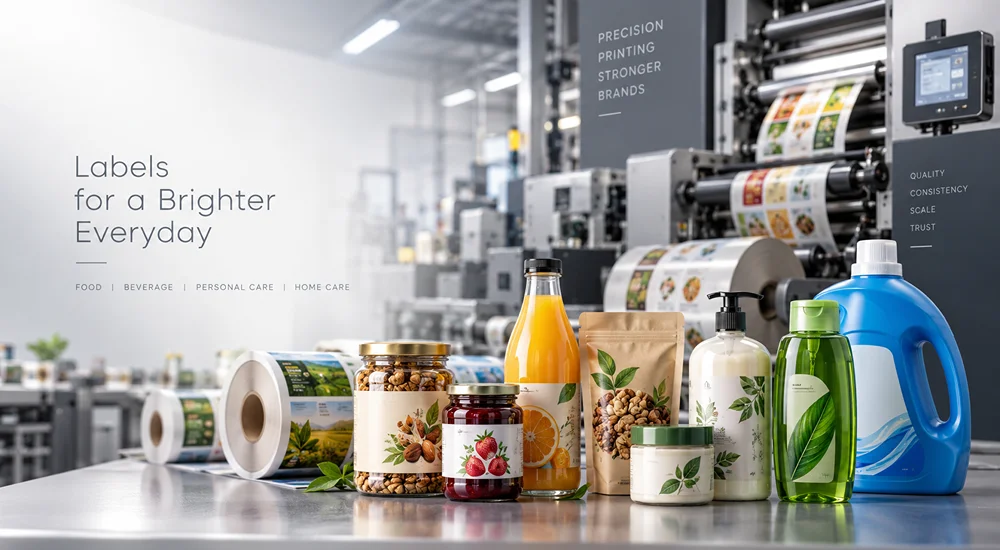
For FMCG brands, a label is much more than a printed piece of packaging. It represents the brand on the shelf, communicates important product information, and needs to maintain its appearance throughout manufacturing, transportation, storage, and retail handling. Choosing the right FMCG label manufacturer therefore becomes an important business decision.
With close to 35 years of experience in printing and packaging, Ideal Wrappers has seen how FMCG packaging requirements have evolved from basic product identification to high-quality, durable, visually consistent labeling solutions.
But what do established FMCG brands actually look for when selecting a labeling partner? The answer goes beyond price.
What Makes a Good FMCG Label Manufacturer?
A reliable label manufacturer in India should be able to combine print quality, material expertise, production consistency, customization, and dependable supply. FMCG companies often manage multiple SKUs, frequent product launches, changing artwork, and large production volumes, making consistency particularly important.
The right manufacturer should understand not only how to print a label but also how the label will perform on the final container and throughout the supply chain.
Consistent Print Quality
FMCG packaging depends heavily on visual consistency. Colours, logos, typography, product images, and other brand elements need to look uniform across different batches and product variants.
Advanced printing capabilities and controlled production processes help maintain colour accuracy, registration, sharp graphics, and consistent finishes. For brands with multiple SKUs, this consistency helps create a recognizable packaging identity across the product range.
Reliable Production for Large Volumes
FMCG manufacturers often require labels in substantial quantities and within defined production schedules. A labeling partner therefore needs the infrastructure and processes to handle large-volume requirements without compromising quality.
Production capacity should be supported by proper quality control, raw material planning, and process monitoring. This becomes especially important when brands have multiple packaging formats or recurring orders.
Label Durability Matters Across the FMCG Supply Chain
A label may pass through several environments before reaching the consumer. It can experience filling operations, warehouse storage, transportation, stacking, retail handling, moisture, abrasion, and temperature variations.
For this reason, an FMCG label manufacturer must consider the actual application rather than simply producing visually attractive labels.
Depending on the product and container, manufacturers may use different technologies. Heat transfer labels can provide a seamless finish and strong resistance to moisture, scratches, and routine handling, while shrink sleeves provide full-body decoration and flexibility for contoured containers.
The right solution should be selected according to:
- Container material and shape
- Product and usage conditions
- Required durability
- Application method
- Production volume
- Branding requirements
- Storage and transportation conditions
This application-focused approach helps brands avoid issues such as peeling, fading, scuffing, poor fit, or inconsistent application.
Why Material and Label Technology Expertise Matters
Not every labeling technology works equally well for every FMCG product. A manufacturer should be able to recommend the appropriate solution based on the container, product environment, and desired appearance.
Common options include heat transfer labels, shrink sleeve labels, wrap-around labels, and self-adhesive labels. Each serves a different packaging requirement.
Heat Transfer Labels
Heat transfer labels are suitable when brands require a seamless, premium appearance on plastic containers. The printed design is transferred directly onto the container using heat and pressure, creating an edge-free finish. They are commonly used where durability and consistent branding are important.
Shrink Sleeve Labels
Shrink sleeves provide 360-degree decoration and can conform to straight, curved, and contoured containers. This makes them particularly useful for visually driven FMCG products where shelf presence and extensive branding space are priorities.
Self-Adhesive and Wrap-Around Labels
Self-adhesive labels offer flexibility for various packaging applications, while BOPP wrap-around labels are commonly used on suitable cylindrical containers and can support efficient high-speed application.
A capable label manufacturer in India should be able to evaluate these options and recommend the technology that best fits the product rather than promoting a single solution for every application.
Customization Is Essential for FMCG Packaging
FMCG brands rarely have a one-size-fits-all packaging strategy. Different products may require different container shapes, label dimensions, finishes, colours, and application methods.
Customization can include:
- Label dimensions and formats
- Material selection
- Print colours and graphics
- Gloss, matte, or metallic effects
- Full-body or partial decoration
- Barcode and QR code integration
- Different packaging variants
- Application-specific performance requirements
For brands managing multiple SKUs, the ability to maintain a consistent visual identity while adapting labels to different containers can be a major advantage.
Quality Control Should Be Built Into the Manufacturing Process
For FMCG brands, quality cannot depend solely on final inspection. Consistency needs to be maintained throughout production from raw materials and printing to finished-label inspection.
Ideal Wrappers highlights in-house material capabilities, advanced printing infrastructure, and systems for monitoring raw materials and finished goods as part of its manufacturing approach. Its printing setup supports up to 10-colour rotogravure printing, while in-house polyester film manufacturing supports heat transfer label production.
A structured quality process helps manufacturers maintain:
Material consistency → Print accuracy → Application performance → Finished packaging quality
This is particularly important for FMCG brands where even small differences can become noticeable across large production runs.
Compliance and Product Information Need Attention
For food and other regulated FMCG products, labels also need to accommodate mandatory product information. For example, FSSAI’s current labelling framework requires applicable packaged foods to carry information such as the food name, ingredients, nutritional information, manufacturer or brand-owner details, net quantity, batch identification, and date marking.
The label also needs to present information clearly and legibly. FSSAI’s regulations require applicable information to remain clear, prominent, indelible, and readily legible under normal conditions of purchase and use.
Therefore, an experienced FMCG label manufacturer should understand the importance of providing sufficient space and print quality for essential information while maintaining the intended packaging design.
Important: Specific labeling requirements vary by product category and applicable regulations, so brands should verify current regulatory requirements for their products before final artwork approval.
Why Supply Reliability Matters to FMCG Brands
A label shortage can affect more than packaging, it can disrupt production schedules and product availability. This makes supply reliability an important consideration when selecting a label manufacturer in India.
Brands should evaluate whether a manufacturer has:
- Adequate production infrastructure
- Reliable raw material sourcing
- Quality control systems
- Capacity for repeat orders
- Experience with large production volumes
- Technical support during development
- Consistent specifications across batches
A long-term manufacturing relationship can help brands achieve greater consistency instead of repeatedly changing suppliers and adjusting packaging specifications.
What 35 Years of Packaging Experience Teaches Us
After decades in printing and packaging, one lesson remains consistent: the cheapest label is not always the most cost-effective label.
A label that performs poorly can result in damaged packaging, production interruptions, inconsistent branding, or reduced shelf appeal. The better approach is to evaluate the complete requirement – material, application, durability, printing, production volume, and supply reliability before selecting a labeling solution.
Ideal Wrappers brings close to 35 years of experience in the printing and packaging industry, supported by in-house capabilities and experience across multiple product categories. The company states that its experience includes working with brands such as Parle, L&T, Godrej, Bharat Petroleum, Videocon, and Indorama.
Choosing an FMCG Label Manufacturer: A Practical Checklist
Before finalizing a supplier, FMCG brands should consider:
Evaluation Area | What to Check |
Printing Quality | Colour consistency, registration, graphics and finish |
Material Expertise | Suitability for the container and application |
Production Capacity | Ability to manage recurring and large-volume orders |
Durability | Performance during handling, storage and transportation |
Customization | Formats, finishes, dimensions and branding requirements |
Quality Control | Raw material and finished-product checks |
Technology | Appropriate labeling technology for the application |
Supply Reliability | Consistent production and repeat-order capability |
Industry Experience | Understanding of FMCG packaging requirements |
Why Choose Ideal Wrappers as Your FMCG Label Manufacturer?
Ideal Wrappers combines packaging experience, manufacturing capabilities, and multiple labeling technologies to support diverse FMCG packaging requirements. Its portfolio includes heat transfer labels, metallized heat transfer labels, shrink sleeves, wrap-around labels, and self-adhesive labeling solutions.With close to 35 years of industry experience, in-house polyester film manufacturing for heat transfer labels, advanced printing infrastructure, and quality-monitoring systems, Ideal Wrappers is positioned to support brands looking for consistent packaging and labeling performance.Whether the priority is durability, 360-degree branding, premium shelf appearance, application efficiency, or consistent large-volume production, the right labeling technology can be selected according to the product and packaging requirement.Conclusion
For FMCG brands, choosing a label manufacturer is ultimately about finding a partner that can deliver consistent quality, reliable performance, production capability, and packaging expertise at scale. A successful labeling solution needs to work not only on the shelf but throughout manufacturing, transportation, storage, and distribution.With close to 35 years of printing and packaging experience, Ideal Wrappers brings together advanced printing technology, in-house manufacturing capabilities, quality-focused processes, and a broad portfolio of labeling solutions. From heat transfer and metallized labels to shrink sleeves and wrap-around labels, Ideal Wrappers works with manufacturers to develop packaging solutions suited to their specific product and container requirements.For FMCG brands looking for a dependable FMCG label manufacturer in India, the right partner is one that understands that every label represents the product, the brand, and the quality promise behind it.Frequently Asked Questions
What should FMCG brands look for in a label manufacturer?
FMCG brands should evaluate print quality, production capacity, material expertise, durability, customization, quality control, supply reliability, and experience with their specific packaging requirements.
Which labeling technologies are commonly used for FMCG packaging?
Common options include heat transfer labels, shrink sleeve labels, wrap-around labels, and self-adhesive labels. The appropriate technology depends on the container, product conditions, branding requirements, and application process.
Why is label consistency important for FMCG brands?
Consistent labels help maintain colour accuracy, brand identity, product recognition, and professional packaging across different production batches and SKUs.
What makes Ideal Wrappers different as a label manufacturer in India?
Ideal Wrappers has close to 35 years of printing and packaging experience, in-house polyester film manufacturing for heat transfer labels, advanced printing capabilities, and a portfolio covering multiple labeling technologies.
How do manufacturers maintain colour consistency across production batches?
The decision depends on the packaging objective. Heat transfer labels are well suited to seamless, durable decoration on compatible plastic containers, while shrink sleeves provide 360-degree coverage and adapt to contoured container shapes.