
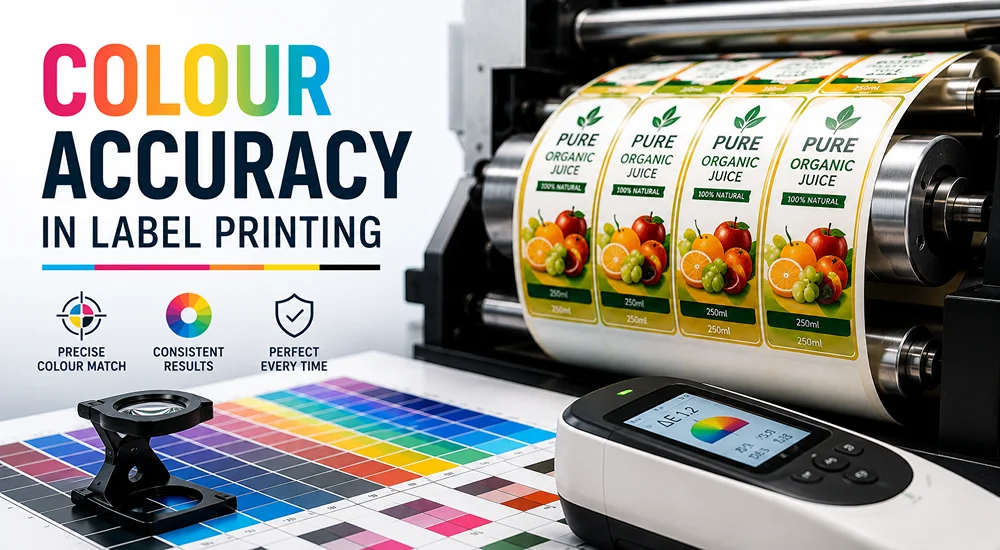
In today’s competitive retail environment, packaging is often the first interaction customers have with a product. Before they read the product description or compare features, they notice the label. Colours, graphics, and branding all influence purchasing decisions within seconds. This is why colour accuracy in label printing is more than a printing requirement, it’s an essential part of building brand recognition and improving shelf performance.
Whether you’re selling beverages, cosmetics, pharmaceuticals, personal care products, food items, or industrial products, consistent colours across every label reinforce trust and professionalism. Even minor colour variations can affect how customers perceive product quality and brand reliability.
Investing in high-quality label printing ensures your packaging looks consistent across every production batch while helping products stand out on crowded retail shelves.
Why Colour Accuracy Is Critical in Label Printing
Colour plays a powerful role in brand identity. Consumers often associate specific colours with well-known brands, making consistency essential for recognition and recall.
When labels display accurate and consistent colours, they help:
- Build brand trust
- Improve product recognition
- Create a premium appearance
- Differentiate products from competitors
- Deliver a consistent customer experience
Whether products are displayed in supermarkets, pharmacies, convenience stores, or online marketplaces, colour consistency helps maintain a strong visual identity.
How Colour Accuracy Influences Brand Shelf Performance
Retail shelves are crowded with competing products. Customers often make buying decisions within a few seconds, making packaging one of the strongest marketing tools available.
Accurate colours improve shelf performance by:
Strengthening Brand Recognition
Consistent brand colours make products instantly recognizable, even from a distance.
When every label matches approved brand colours, customers can quickly identify familiar products without reading the packaging.
Increasing Shelf Visibility
Bright, vibrant, and accurately reproduced colours naturally attract attention.
Poor colour reproduction can make products appear dull, reducing their ability to stand out against competing brands.
Building Consumer Confidence
Customers associate high-quality packaging with high-quality products.
Labels with faded colours, inconsistent printing, or poor registration may create doubts about product authenticity and manufacturing standards.
Supporting Product Differentiation
Many brands use colour coding to distinguish product variants.
Examples include:
- Different beverage flavours
- Cosmetic shades
- Pharmaceutical strengths
- Automotive fluids
- Household cleaners
Accurate colour reproduction ensures customers can quickly identify the correct product.
Common Causes of Colour Variation in Label Printing
Maintaining colour consistency requires precise control throughout the printing process.
Several factors can lead to colour variation.
Incorrect Colour Calibration
Printing equipment should be calibrated regularly to maintain consistent colour output across production batches.
Poor Ink Quality
Low-quality inks may produce inconsistent shades and fade over time.
Premium inks provide better colour stability and long-lasting print performance.
Differences in Label Materials
Paper labels, film labels, shrink sleeves, and pressure-sensitive labels can reproduce colours differently.
Selecting the right substrate is essential for accurate colour matching.
Inconsistent Printing Processes
Different printing technologies may produce slight colour variations if proper quality control measures are not followed.
Technologies That Improve Colour Accuracy in Label Printing
Modern printing technologies help manufacturers achieve consistent colour reproduction.
Some commonly used methods include:
Flexographic Printing
Ideal for high-volume production while maintaining excellent colour consistency and print quality.
Rotogravure Printing
Provides exceptional colour depth, sharp graphics, and premium-quality packaging for large production runs.
Digital Label Printing
Suitable for shorter production runs and variable data printing while maintaining impressive colour precision.
Each printing method has its advantages depending on production volume, packaging material, and branding requirements.
The Role of Colour Management in Packaging
Professional label printing relies on colour management systems that ensure every production run matches approved brand colours.
Effective colour management includes:
- Pantone colour matching
- CMYK colour calibration
- Digital proof approval
- Print quality inspections
- Batch-to-batch consistency
- Press calibration
These practices help maintain uniform branding across multiple product lines and packaging formats.
Industries Where Colour Accuracy Makes the Biggest Difference
Almost every industry benefits from consistent label colours.
Examples include:
- Food and beverage
- Cosmetics and personal care
- Pharmaceuticals
- Nutraceuticals
- Household products
- Automotive fluids
- Agrochemicals
- Industrial chemicals
- Health supplements
In highly competitive industries, accurate colours help improve product visibility and strengthen brand identity.
How High-Quality Label Printing Supports Long-Term Brand Growth
Consistent packaging creates lasting impressions.
High-quality label printing helps brands:
- Improve shelf appeal
- Enhance customer recognition
- Reduce packaging errors
- Maintain consistent branding
- Improve product presentation
- Strengthen consumer trust
- Minimize costly reprints
- Support premium product positioning
Rather than being viewed as a production expense, quality label printing becomes an investment in long-term brand success.
What to Look for in a Label Printing Partner
Choosing the right printing partner is just as important as selecting the right packaging material.
Look for a manufacturer that offers:
- Advanced printing technology
- Strict colour quality control
- Pantone colour matching capabilities
- Experience across multiple industries
- High-quality inks and substrates
- Consistent production standards
- Reliable delivery timelines
- Custom labeling solutions
A dependable label manufacturer helps maintain brand consistency across every product launch and production cycle.
Conclusion
Colour is one of the strongest visual elements influencing how customers perceive a product. Consistent, accurate colours help brands build recognition, improve shelf visibility, and create lasting customer trust. Investing in high-quality colour accuracy in label printing ensures your packaging maintains a professional appearance across every batch while supporting stronger brand performance in competitive markets.
At Ideal Wrappers, we combine advanced printing technologies, strict quality control, and premium materials to deliver high-performance labeling solutions that meet demanding brand standards. Whether you need shrink sleeve labels, pressure-sensitive labels, heat transfer labels, or wrap-around labels, our expertise in precision label printing helps ensure consistent colours, superior print quality, and packaging that makes a lasting impression.
Frequently Asked Questions
Why is colour accuracy important in label printing?
Colour accuracy ensures consistent branding, improves product recognition, enhances shelf appeal, and builds consumer trust across every packaging batch.
How does colour consistency affect brand recognition?
Consistent colours make products instantly recognizable, helping customers identify familiar brands quickly while reinforcing brand identity.
What causes colour variation in label printing?
Colour variation can result from poor press calibration, inconsistent inks, differences in label materials, improper colour management, and inadequate quality control.
Which printing methods provide the best colour accuracy?
Flexographic printing, rotogravure printing, and digital label printing all offer excellent colour reproduction when supported by proper colour management and quality assurance processes.
How do manufacturers maintain colour consistency across production batches?
Manufacturers use Pantone colour matching, CMYK calibration, digital proofing, regular press calibration, premium inks, and strict quality inspections to maintain consistent colours.