
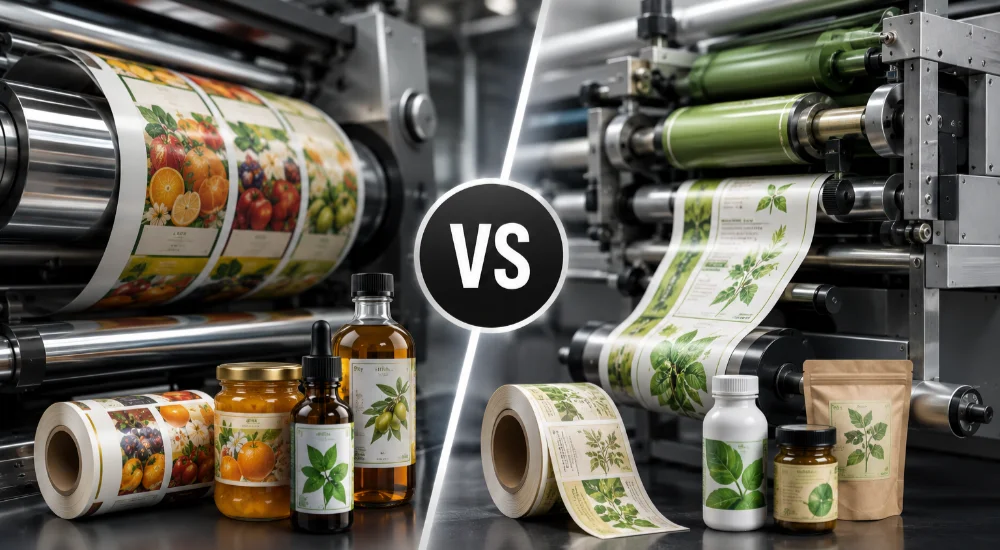
When it comes to label manufacturing, printing technology plays a major role in determining the final output. From color consistency to durability, the choice of printing method directly impacts how your product looks and performs in the market. This is why the comparison of rotogravure vs flexo printing has become an important topic for businesses looking to optimize their packaging.
Both technologies are widely used in the labeling industry, but they serve different purposes depending on production requirements. Understanding their differences can help manufacturers choose the right solution for quality, efficiency, and cost-effectiveness.
What is Rotogravure Printing?
Rotogravure printing is a high-quality printing process that uses engraved cylinders to transfer ink onto the substrate. It is widely recognized for its precision and ability to deliver consistent results across large production runs. This makes it a preferred choice for industries where uniformity and detail are essential.
One of the key strengths of rotogravure printing lies in its excellent color consistency across batches, ensuring that every label looks identical even in high-volume production. It also offers high-resolution print quality, making it ideal for intricate designs, fine details, and smooth gradients. Because of its efficiency in long production runs, rotogravure is commonly used for premium packaging and large-scale label manufacturing where maintaining consistent visual quality is critical.
What is Flexo Printing?
Flexographic printing, commonly known as flexo printing, uses flexible relief plates to transfer ink onto the substrate. It is widely appreciated for its speed and versatility, making it a practical choice for many packaging applications. This printing method is especially useful when quick production and adaptability are required.
One of the key advantages of flexo printing is its faster setup and production speed, which helps manufacturers meet tight timelines. It is also cost-effective for shorter runs, making it suitable for businesses that require frequent design changes or smaller batch production. Flexo printing works well with a variety of materials, adding to its flexibility across different packaging needs. While it is best suited for simpler designs, it remains a reliable option for applications where efficiency and quick turnaround are important.
Rotogravure vs Flexo Printing: Key Differences
Understanding the differences between rotogravure vs flexo printing helps in selecting the right technology for your product.
Print Quality and Detail
Rotogravure printing delivers superior print quality with sharp details and smooth gradients. It is ideal for complex designs that require precision. Flexo printing, while effective, may not achieve the same level of detail as rotogravure, especially for intricate graphics. However, modern flexo technology has improved significantly, offering better print clarity for standard packaging applications.
Color Consistency
Rotogravure offers consistent color reproduction across large volumes, making it suitable for brands that require uniform packaging. Flexo printing can deliver good results, but slight variations may occur across batches. With advanced color management systems, flexo printing can still maintain acceptable consistency for many packaging needs.
Production Volume
Rotogravure is best suited for high-volume production due to its efficiency in long runs. Flexo printing is more flexible and cost-effective for shorter production runs or frequent design changes. This flexibility makes flexo a preferred option for brands with multiple SKUs or changing packaging designs.
Cost Considerations
Initial setup costs for rotogravure printing are higher due to engraved cylinders, but the cost per unit decreases significantly in large volumes. Flexo printing has lower setup costs, making it suitable for smaller batches and shorter runs. It is also more economical for businesses that require quick changes without significant investment in setup.
Versatility and Application
Flexo printing offers greater flexibility in terms of materials and applications. Rotogravure, on the other hand, is preferred for premium packaging where quality and consistency are the priority. Flexo can efficiently handle a wide range of substrates, making it suitable for diverse packaging formats and industries.
Which Printing Method is Better for Labels?
The answer depends on your specific requirements. If your focus is on high-quality output, detailed designs, and large-scale production, rotogravure printing is often the better choice.
However, if you need flexibility, faster turnaround, and cost-effective solutions for smaller volumes, flexo printing can be more suitable.
Businesses should evaluate factors such as production volume, design complexity, and budget before making a decision.
Factors to Consider Before Choosing
Product Type
Different products require different labeling approaches. Industrial packaging may need durable and consistent labeling, while consumer products may prioritize visual appeal. Products exposed to harsh conditions like moisture, oil, or rough handling require more robust printing solutions. Choosing the right method ensures the label performs well throughout the product lifecycle.
Design Requirements
Complex designs with multiple colors and gradients are better suited for rotogravure printing. Simpler designs can work well with flexo printing. High-end branding often demands sharp details and smooth color transitions, which rotogravure can deliver effectively. Flexo, however, is ideal for straightforward designs where speed and cost efficiency are priorities.
Production Scale
High-volume production favors rotogravure, while smaller batches benefit from flexo printing. Rotogravure becomes more cost-efficient as production volume increases due to consistent output. Flexo printing is better suited for short runs or projects that require frequent design updates.
Budget and Timeline
Budget constraints and production timelines play a key role in choosing the right printing method. While rotogravure may involve higher initial setup costs, it offers long-term savings for large volumes. Flexo printing, on the other hand, provides quicker turnaround times and lower upfront costs, making it suitable for time-sensitive projects.
Conclusion
The comparison of rotogravure vs flexo printing highlights that both technologies have their own strengths. The right choice depends on your product requirements, production scale, and quality expectations.
Ideal Wrappers leverages advanced printing technologies to deliver high-quality labeling solutions tailored to diverse industry needs. With expertise in rotogravure printing and modern packaging solutions, Ideal Wrappers helps businesses achieve consistent, durable, and visually appealing labels that enhance product performance and brand value.
Frequently Asked Questions
What is the main difference between rotogravure vs flexo printing?
Rotogravure offers higher print quality and consistency, while flexo printing is more flexible and cost-effective for shorter runs.
Which printing method is better for high-volume label production?
Rotogravure printing is better for high-volume production due to its consistency and efficiency.
Is flexo printing cheaper than rotogravure?
Flexo printing has lower setup costs, making it suitable for smaller batches, while rotogravure becomes cost-effective in large volumes.
Which printing method gives better label quality?
Rotogravure printing provides superior quality with sharper details and better color consistency.
Can both methods be used for packaging labels?
Yes, both rotogravure and flexo printing are used for packaging labels, depending on the application and requirements.