
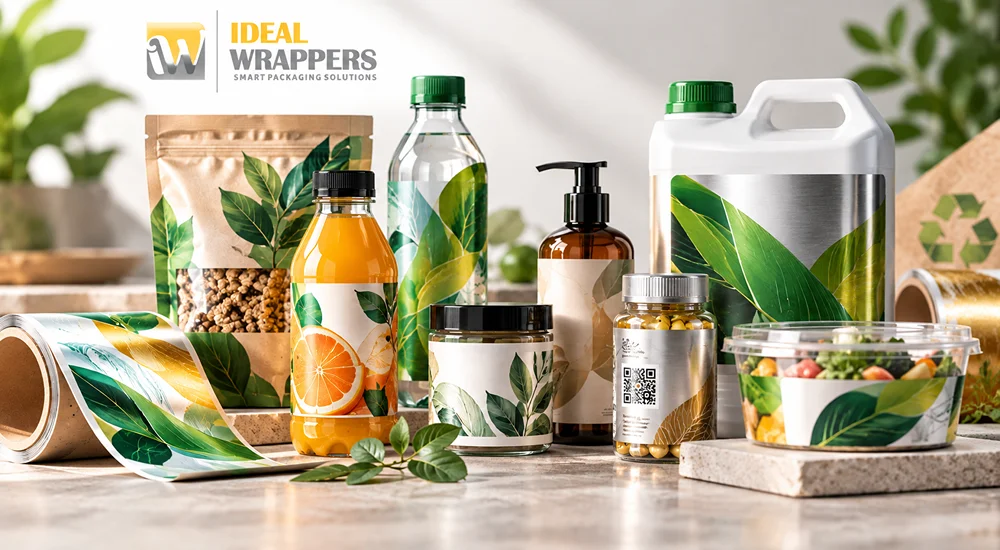
Packaging in 2026 is no longer viewed only as a way to protect a product. For Indian brands, packaging increasingly has to balance product protection, shelf appeal, sustainability, information, convenience and supply-chain performance.
The latest packaging trends in India reflect this broader shift. Market growth is being supported by FMCG, food and beverage, personal care, pharmaceuticals, agriculture, e-commerce and organised retail, while sustainability and technology are influencing packaging decisions.
For brand managers, understanding these packaging industry trends 2026 can help with packaging development, label selection, product launches and long-term brand positioning.
1. Sustainability Is Becoming a Packaging Design Priority
Sustainability continues to influence packaging material and design decisions in India. Brands are increasingly evaluating recyclability, recycled content, lightweighting, material efficiency and end-of-life management rather than looking at packaging only from a production-cost perspective.
India’s Extended Producer Responsibility framework for plastic packaging includes targets related to recycling, reuse and recycled content, making packaging waste management an important consideration for businesses.
This means brand managers need to consider sustainability earlier in the packaging-development process.
What This Means for Brands
Instead of simply asking, “What is the most attractive packaging?”, packaging teams increasingly need to ask:
- Can the packaging be efficiently recovered or recycled?
- Can material use be reduced without affecting performance?
- Does the packaging support the brand’s sustainability objectives?
- What are the applicable EPR requirements?
Sustainability should therefore be considered alongside performance, cost and product protection.
2. Flexible and Lightweight Packaging Will Continue to Grow
Flexible packaging remains an important part of India’s packaging landscape because of its versatility, material efficiency and suitability for FMCG applications. Industry data indicates continued growth in flexible formats alongside demand for lightweight and recyclable structures.
For brands, lightweight packaging can offer potential benefits in material usage, transportation and storage, but the format still needs to provide adequate protection for the product.
The Shift Is From “Less Material” to “Smarter Material”
The important trend is not simply using less packaging. It is choosing a packaging structure that delivers the required performance with efficient material use.
Barrier properties, seal performance, durability, product compatibility and recyclability all need to be considered together.
3. Packaging Will Play a Bigger Role in Brand Differentiation
With more products competing across organised retail, e-commerce and quick-commerce channels, packaging has become an important brand touchpoint.
This is particularly relevant for FMCG, beverages, food, personal care and household products, where consumers may make quick comparisons between competing products.
High-quality printing, distinctive graphics, colour consistency, premium finishes and well-designed labels can help packaging communicate brand identity.
For label-intensive applications, technologies such as heat transfer labels and shrink sleeves can provide extensive branding opportunities while adapting to different packaging formats.
4. Smart and Connected Packaging Is Expanding
Another important direction within the packaging industry trends 2026 landscape is the growing use of connected packaging technologies.
QR codes, NFC and other digital technologies can connect physical packaging with digital information. Industry sources identify smart packaging as an emerging application for areas such as product authentication and supply-chain efficiency.
How Brands Can Use Connected Packaging
Depending on the product and business objective, a connected pack can support:
- Product information
- Authentication
- Consumer engagement
- Traceability
- Digital campaigns
- Post-purchase communication
However, technology should solve a specific business or consumer need rather than being added simply because it is a trend.
5. Premium Packaging and Personalisation Are Gaining Importance
Premiumisation is influencing packaging across several Indian consumer categories. Recent FMCG activity shows continued focus on premium products, health and wellness and differentiated consumer offerings.
Packaging plays an important role in communicating that positioning.
Premium packaging can involve:
- High-quality printing
- Refined typography
- Metallic or specialty visual effects
- Matte or gloss finishes
- Detailed graphics
- Distinctive label structures
- Personalised or limited-edition designs
For brand managers, the objective should be to create perceived value without compromising packaging functionality.
6. Packaging Must Work Across Retail and E-Commerce
The growth of e-commerce and quick-commerce is changing how packaging needs to perform. Packaging may experience more movement, handling and distribution points before reaching the consumer.
India’s packaging growth is being supported partly by e-commerce and organised retail, increasing the importance of packaging that works across different distribution environments.
What Brand Managers Should Review
Before approving a packaging format, consider:
- Transportation durability
- Product protection
- Label adhesion
- Print durability
- Barcode readability
- Pack dimensions
- Shelf presentation
- Resistance to moisture and handling
A package that looks excellent on a retail shelf must also survive the supply chain.
7. Labels Will Become More Functional, Not Just Decorative
One of the most relevant packaging trends for brands is the increasing role of labels as information and identification tools.
Labels need to communicate product information while supporting brand recognition, traceability, barcodes, batch identification and consumer understanding, depending on the product category.
This makes label selection an important part of overall packaging development.
The choice between self-adhesive labels, heat transfer labels, shrink sleeves or other labeling technologies should depend on the packaging surface, product environment, desired appearance and performance requirements.
What Indian Brand Managers Should Prepare for in 2026
Rather than following every new packaging trend, brands should evaluate trends against their actual business requirements.
A practical packaging review should consider:
Sustainability: Is the material and format aligned with applicable environmental requirements?
Performance: Can the packaging withstand storage, transportation and handling?
Branding: Does the pack communicate the intended positioning clearly?
Technology: Could connected features improve authentication, traceability or engagement?
Consumer experience: Is the packaging easy to understand and use?
Scalability: Can the chosen packaging solution support future production volumes and product variations?
This approach allows brand managers to turn packaging trends in India into practical packaging decisions rather than simply following market buzz.
Conclusion
The most important packaging trends 2026 point toward a packaging industry that is becoming more sustainable, technology-enabled, visually differentiated and performance-focused. Sustainability, flexible formats, smart packaging, premiumisation, e-commerce requirements and functional labeling are all influencing how brands approach packaging.
For Indian brands, the key is not to adopt every trend. It is to identify which developments support their product, target consumer, distribution model and brand objectives.
With experience across packaging and labeling applications, Ideal Wrappers provides solutions including heat transfer labels, shrink sleeves and self-adhesive labels for industries such as food and beverage, personal care, home care, agriculture and consumer products. By combining appropriate labeling technology with packaging requirements, brands can build packaging that supports both visual differentiation and practical performance.
Frequently Asked Questions
What are the major packaging trends in India for 2026?
Major packaging trends in India include greater attention to sustainability, lightweight and flexible packaging, smart and connected packaging, premiumisation, e-commerce-ready packaging and more functional labeling.
How is sustainability changing packaging in India?
Brands are increasingly considering recyclability, recycled content, material efficiency, reuse and end-of-life management. India’s EPR framework is also making packaging-waste responsibilities an important consideration for businesses.
How are smart packaging technologies being used?
Technologies such as QR codes and NFC can connect physical packaging to digital experiences and can support applications including authentication, product information, traceability and consumer engagement.
Why are labels important in modern packaging?
Labels do more than display branding. Depending on the product, they can communicate essential information, support identification and traceability, display barcodes and contribute significantly to shelf presentation.
How should brands choose a packaging solution in 2026?
Brands should evaluate the product, packaging material, storage and transportation conditions, sustainability requirements, consumer experience, labeling needs and production scalability before selecting a packaging format.