
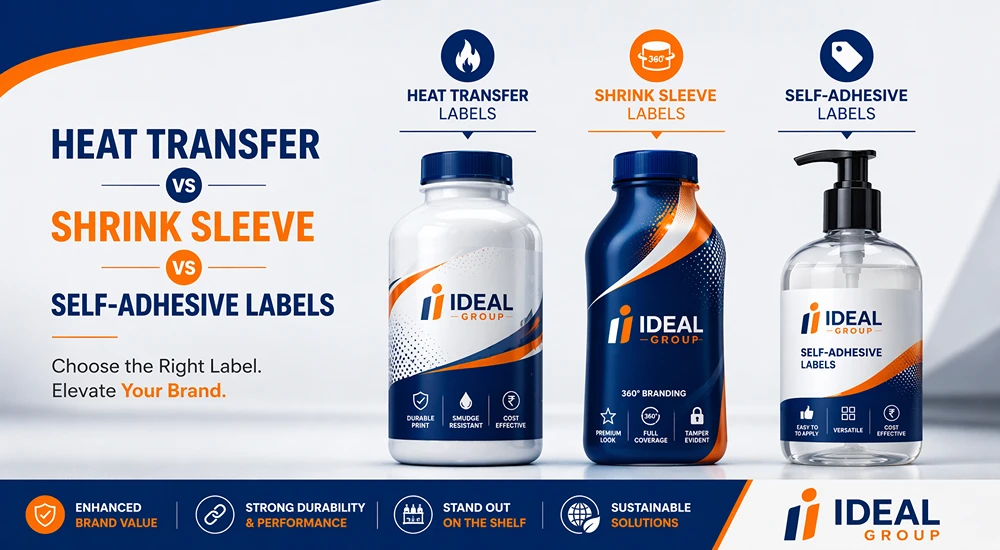
Choosing the best label for containers is not as simple as it seems. Different products require different labeling approaches depending on container material, usage conditions, and branding needs. With multiple types of labels for packaging available today, businesses often find it challenging to decide which option will deliver the best results.
Among the most commonly used labeling solutions are heat transfer labels, shrink sleeve labels, and self-adhesive labels. Each of these has its own advantages and is suited for specific applications. Understanding their differences can help manufacturers select the right labeling solution for durability, efficiency, and visual appeal.
Understanding the Main Types of Labels for Packaging
Modern packaging relies on three widely used labeling technologies:
- Heat transfer labels
- Shrink sleeve labels
- Self-adhesive labels
Each of these labeling methods is designed to meet different packaging requirements. The right choice depends on factors such as container shape, environmental exposure, and production scale.
Heat Transfer Labels: Seamless and Durable
Heat transfer labels are applied using heat and pressure, transferring the design directly onto the container surface. This creates a smooth, edge-free finish that becomes part of the packaging. This labeling method is widely used in industries such as paints, lubricants, and household products, where durability is critical.
Key Benefits:
- Seamless appearance with no peeling edges
- High durability against moisture and scratches
- Ideal for plastic containers and industrial packaging
- Long-lasting product identification
Shrink Sleeve Labels: Full-Body Branding
Shrink sleeve labels are applied as a sleeve over the container and then shrunk using heat to fit tightly around its shape. This allows for 360-degree branding, making it a popular choice for visually driven products. Shrink sleeves are commonly used in personal care, beverages, and consumer goods packaging, where shelf appeal plays a major role.
Key Benefits:
- Full container coverage for branding
- Suitable for complex shapes and designs
- High visual impact on retail shelves
- Supports detailed product information
Self-Adhesive Labels: Simple and Cost-Effective
Self-adhesive labels are the most traditional labeling option. They are applied directly onto containers using adhesive backing. While they are convenient, they may not offer the same durability as other labeling methods in demanding environments.
Key Benefits:
- Easy and quick application
- Cost-effective for low to medium production volumes
- Suitable for flat or slightly curved surfaces
- Flexible for short production runs
Comparison: Which Label Is Best for Your Container?
| Feature | Heat Transfer Labels | Shrink Sleeve Labels | Self-Adhesive Labels |
| Durability | High | Moderate to High | Moderate |
| Appearance | Seamless | Full-body branding | Visible edges |
| Container Compatibility | Best for plastic | Works on all shapes | Best for simple shapes |
| Cost Efficiency | Medium | Medium | Low |
| Branding Impact | Premium | Very High | Standard |
Factors to Consider Before Choosing
Container Material
Plastic containers work well with heat transfer labels, while shrink sleeves adapt to various shapes and materials. The surface texture and flexibility of the container also influence how well a label adheres or bonds. Choosing the right labeling method ensures better durability and prevents issues like peeling, wrinkling, or misalignment during application.
Environmental Conditions
Products exposed to moisture, oil, or rough handling require durable labeling solutions. Labels used in such conditions must resist fading, scratches, and chemical exposure to maintain readability. This is especially important for industrial and outdoor packaging, where labels are expected to perform reliably throughout the product lifecycle.Branding Requirements
Branding Requirements
If visual appeal is a priority, shrink sleeve labels offer maximum branding space. They allow for high-quality graphics, vibrant colors, and full-body decoration that enhances shelf visibility. This makes them ideal for products where packaging design plays a key role in attracting customers and influencing buying decisions.
Production Volume
For high-volume manufacturing, automated labeling solutions like heat transfer or shrink sleeves are more efficient. These technologies support consistent application across large batches, reducing manual errors and improving production speed. Efficient labeling processes also help businesses maintain uniform packaging quality while optimizing operational costs.
Budget
Self-adhesive labels are suitable for cost-sensitive applications, while advanced labeling solutions offer long-term value. Although initial costs may vary, durable labels can reduce rework, replacements, and wastage over time. Businesses should consider both short-term expenses and long-term performance when selecting the right labeling solution.
Choosing the Right Labeling Solution
There is no single answer when it comes to selecting the right labeling method. Each of the types of labels for packaging serves a specific purpose. The decision should be based on product requirements, packaging design, and operational needs.
Businesses that prioritize durability and seamless appearance often prefer heat transfer labels. Those focusing on branding and shelf visibility choose shrink sleeve labels. Meanwhile, self-adhesive labels remain a practical choice for simple and cost-effective applications.
Conclusion
Understanding the differences between heat transfer, shrink sleeve, and self-adhesive labels helps businesses make informed packaging decisions. Choosing the best label for containers ensures not only better product presentation but also improved durability and operational efficiency.
Ideal Wrappers offers a wide range of advanced labeling solutions, including heat transfer labels, shrink sleeves, and wrap around labels, designed to meet diverse industry needs. With a strong focus on quality and innovation, Ideal Wrappers helps businesses achieve reliable packaging performance and consistent brand presentation across different applications.
Frequently Asked Questions
What are the main types of labels for packaging?
The main types of labels for packaging include heat transfer labels, shrink sleeve labels, and self-adhesive labels, each suited for different applications.
Which is the best label for containers?
The best label for containers depends on the application. Heat transfer labels are best for durability, shrink sleeves for branding, and self-adhesive labels for cost-effective solutions.
Are shrink sleeve labels better than self-adhesive labels?
Shrink sleeve labels offer better branding and flexibility, while self-adhesive labels are more cost-effective and easier to apply.
Why are heat transfer labels used in industrial packaging?
Heat transfer labels provide strong durability, seamless finish, and resistance to harsh conditions, making them ideal for industrial packaging.