
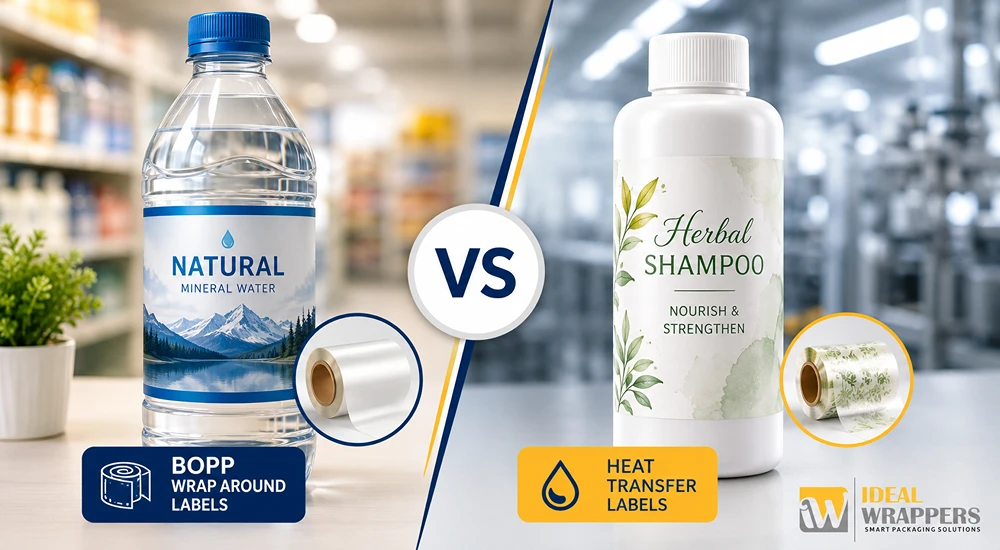
Selecting the right labeling solution is more than a branding decision, it directly impacts product appearance, production efficiency, durability, and cost. For manufacturers in the beverage, dairy, personal care, home care, and consumer goods industries, BOPP wrap around labels and heat transfer labels are two of the most widely used decoration methods. While both enhance packaging, they serve different purposes based on container type, production requirements, and branding goals.
If you’re unsure which option best suits your products, this guide compares BOPP wrap around labels and heat transfer labels in terms of application, performance, cost, durability, and ideal use cases to help you make an informed packaging decision.
What Are BOPP Wrap Around Labels?
BOPP wrap around labels are labels made from Biaxially Oriented Polypropylene (BOPP) film that wrap around a container and are bonded using hot melt adhesive or cold glue. These labels provide excellent print quality, moisture resistance, and cost-effective branding for high-volume packaging applications. The use of high-quality BOPP film ensures excellent clarity, durability, and dimensional stability, making it an ideal material for modern packaging and labeling applications.
A BOPP label is widely used on PET bottles, plastic containers, and jars because it delivers a premium appearance while supporting fast production speeds.
Common Applications of BOPP Wrap Around Labels
- Bottled water
- Carbonated beverages
- Dairy products
- Juice bottles
- Edible oil containers
- Food packaging
- Household cleaning products
- Personal care packaging
What Are Heat Transfer Labels?
Heat transfer labels are printed designs transferred directly onto plastic containers using heat and pressure. Unlike conventional labels, there is no separate adhesive-backed film after application, resulting in a seamless, “no-label” appearance.
Heat transfer labels become part of the container surface, making them highly resistant to peeling, scratching, and moisture. They are commonly used for HDPE, PP, and industrial plastic containers where durability is a priority.
Common Applications of Heat Transfer Labels
- Paint buckets
- Lubricant bottles
- Agrochemical containers
- Industrial packaging
- Home care products
- Cosmetic jars
- Food-grade plastic containers
BOPP Wrap Around Labels vs Heat Transfer Labels: Key Differences
| Feature | BOPP Wrap Around Labels | Heat Transfer Labels |
| Material | BOPP Film | Printed transfer film |
| Application | Wrapped with adhesive | Heat transferred directly |
| Appearance | Premium wrap-around finish | Seamless, no-label look |
| Durability | High moisture resistance | Excellent scratch and chemical resistance |
| Best For | PET bottles and round containers | HDPE, PP, and molded containers |
| Production Speed | High-speed labeling lines | Integrated heat transfer process |
| Branding Area | Nearly full-body decoration | High-quality container decoration |
| Cost Efficiency | Excellent for high-volume production | Ideal for premium and industrial applications |
When Should You Choose BOPP Wrap Around Labels?
BOPP wrap around labels are the preferred choice when manufacturers require attractive packaging, efficient production, and economical labeling for large production volumes.
Choose BOPP Wrap Around Labels If You Need:
- High-speed automated labeling
- Cost-effective packaging for mass production
- Excellent print clarity and vibrant graphics
- Moisture-resistant labeling
- Premium shelf appeal
- Lightweight labeling solution
- Branding for PET bottles and cylindrical containers
Industries producing beverages, dairy products, packaged food, and personal care products often choose BOPP labels because they combine visual appeal with production efficiency.
When Are Heat Transfer Labels the Better Choice?
Heat transfer labels are ideal when durability and long-term performance are more important than removable labeling.
Choose Heat Transfer Labels If You Need:
- Permanent decoration
- Scratch-resistant packaging
- Chemical-resistant labels
- Labels that won’t peel during transportation
- Industrial-grade durability
- High-performance labeling for HDPE and PP containers
Manufacturers of lubricants, paints, agrochemicals, and household chemicals frequently use heat transfer labels because they withstand demanding storage and handling conditions.
Factors to Consider Before Choosing a Labeling Solution
Choosing between BOPP wrap around labels and heat transfer labels depends on several practical considerations.
Container Material
- PET bottles → BOPP wrap around labels
- HDPE containers → Heat transfer labels
- PP containers → Heat transfer labels
- Plastic jars → Depends on branding requirements
Product Category
Your product category influences the most suitable labeling method.
Examples include:
- Beverages
- Dairy
- Food products
- Cosmetics
- Home care
- Industrial chemicals
- Agrochemicals
Packaging Environment
Consider whether the packaging will be exposed to:
- Moisture
- Refrigeration
- Chemicals
- Frequent transportation
- Outdoor storage
Branding Objectives
If your priority is maximum shelf visibility, BOPP labels provide excellent graphic quality.
If durability and product protection are the priority, heat transfer labels offer a long-lasting solution.
Which Industries Commonly Use BOPP Wrap Around Labels?
BOPP wrap around labeling has become a preferred solution across multiple industries because of its versatility and production efficiency.
Industries include:
- Beverage manufacturing
- Dairy processing
- Packaged food
- Edible oils
- Home care
- Personal care
- Consumer goods
- FMCG packaging
The excellent print quality, flexibility, and compatibility with automated production lines make BOPP wrap around labels a reliable solution for high-volume manufacturing.
Conclusion
Both BOPP wrap around labels and heat transfer labels offer distinct advantages, and the best choice depends on your product, container material, production environment, and branding objectives. While BOPP labels are ideal for high-volume consumer packaging with excellent shelf appeal and cost efficiency, heat transfer labels provide unmatched durability for industrial and heavy-duty applications.
At Ideal Wrappers, we manufacture high-quality labeling solutions designed to meet the diverse needs of modern packaging industries. Whether you require BOPP wrap around labels for beverage and FMCG packaging or durable heat transfer labels for industrial containers, our team helps you select the right solution based on your product requirements, production process, and branding goals.
Frequently Asked Questions
What are BOPP wrap around labels used for?
BOPP wrap around labels are primarily used for PET bottles, beverage packaging, dairy products, food containers, and personal care products where high-quality branding and efficient production are required.
Are BOPP labels waterproof?
Yes. BOPP labels offer excellent resistance to moisture, making them suitable for refrigerated products and environments where condensation is common.
Which is more durable: BOPP wrap around labels or heat transfer labels?
Heat transfer labels generally provide greater resistance to scratching, abrasion, and chemicals because the decoration becomes part of the container surface. BOPP wrap around labels, however, offer excellent durability for most consumer packaging applications.
Can BOPP wrap around labels be used on plastic bottles?
Yes. They are widely used on PET bottles, plastic containers, and cylindrical packaging across the beverage, food, and personal care industries.
How do I choose between BOPP wrap around labels and heat transfer labels?
The right choice depends on your container material, product application, branding goals, durability requirements, and production process. Evaluating these factors helps determine the most suitable labeling solution for your packaging.