
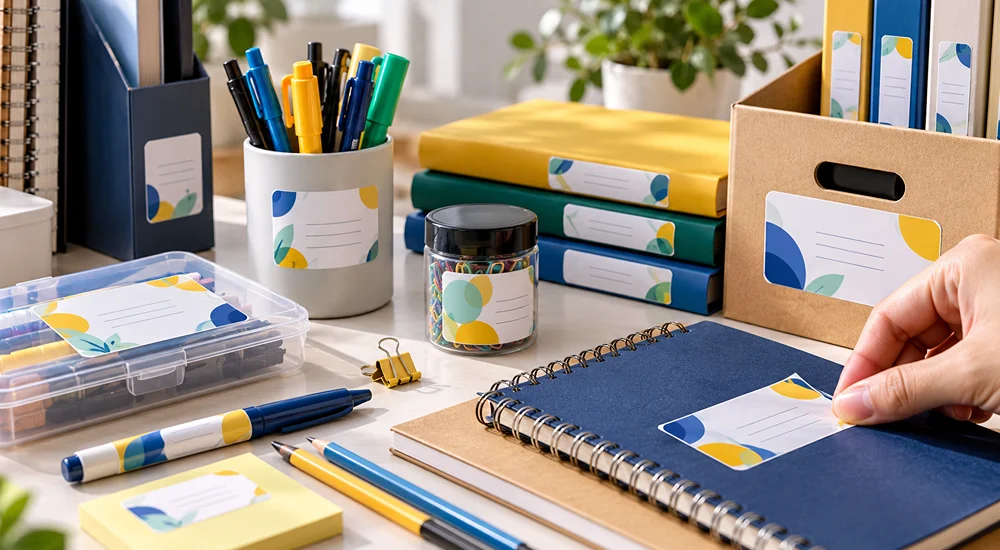
For stationery and consumer products, packaging often has to make a strong visual impression while withstanding regular handling. Stationery labels are not simply decorative elements; they can communicate product identity, brand information and key product details while contributing to the overall packaging experience.
A well-designed label should therefore balance visual appeal with durability. Sharp printing, accurate colours, reliable adhesion and resistance to everyday handling can help maintain the appearance and functionality of stationery packaging labels throughout the product’s journey from manufacturing to the consumer.
Why Design Matters for Stationery and Consumer Goods Labels
Stationery products compete across retail stores, supermarkets, online marketplaces and other sales channels. When several products serve similar purposes, packaging design can help a brand stand out.
Strong Visual Identity Improves Product Recognition
Effective labels for stationery products should make the brand and product easy to identify. Consistent use of colours, typography, graphics and brand elements can create recognition across a product range.
For example, notebooks, writing instruments, art supplies, adhesive products and other stationery items can use a consistent labeling approach while still allowing individual products to have their own visual identity.
Print Quality Influences Perceived Product Quality
Blurred graphics, inconsistent colours or poorly reproduced text can make packaging appear less professional. High-quality printing helps maintain the intended appearance of the artwork and allows important product information to remain clear.
For consumer goods labels, colour accuracy and graphic consistency can become particularly important when packaging is used across multiple products or production batches.
Why Durability Is Equally Important
An attractive label loses its value if it starts peeling, fading, scratching or becoming difficult to read during normal handling.
Stationery products can be touched, moved, stacked and transported repeatedly before reaching the consumer. Depending on the product and packaging format, labels may also experience friction, moisture or exposure to different storage conditions.
Common Durability Challenges
Stationery labels may need to withstand:
- Frequent handling
- Abrasion and rubbing
- Stacking and transportation
- Moisture or humidity
- Storage conditions
- Contact with other products
- Repeated movement during retail handling
The exact requirements depend on the product, packaging material and expected environment.
Design and Durability Must Work Together
Design and durability should not be treated as separate packaging decisions. A visually impressive label still needs to perform effectively on its intended packaging surface.
Match the Label to the Packaging Surface
Plastic, paperboard, metal and other packaging substrates can have different surface characteristics. Container shape, texture, flexibility and surface condition can influence label application and adhesion.
Choosing the appropriate label material and adhesive for the packaging surface can help reduce problems such as lifting, wrinkles or premature label failure.
Consider the Product’s Handling Environment
Before selecting a labeling solution, manufacturers should consider how the product will be stored, transported and handled.
For example, products that experience frequent rubbing may require stronger abrasion resistance, while packaging exposed to moisture may require a solution designed for those conditions.
What Should Good Stationery Packaging Labels Communicate?
A label should help consumers understand the product without making the packaging visually confusing.
Depending on the product, stationery packaging labels may communicate:
- Product name and type
- Brand identity
- Product features or benefits
- Quantity or size
- Usage information
- Manufacturer or company details
- Barcode or other identification information
- Applicable product information
Clear information hierarchy helps consumers quickly identify the product while maintaining an attractive package design.
How to Choose Labels for Stationery Products
There is no single label solution that suits every stationery or consumer product. Selection should be based on the packaging format, product requirements and expected conditions.
Consider the Packaging Format
A flat paperboard package may require different labeling considerations from a curved plastic container or rigid consumer product.
Evaluate the surface, shape, dimensions and flexibility of the packaging before finalizing the label.
Evaluate Print and Application Requirements
Consider the required level of colour accuracy, graphics, text detail and finishing. At the same time, evaluate how the label will be applied and whether it needs to conform to a particular shape.
Test Before Full-Scale Production
Testing labels on the actual packaging can help identify potential issues with adhesion, positioning, appearance and durability.
A sample evaluation can be especially useful when changing packaging materials, artwork, label construction or application processes.
A Practical Checklist for Better Consumer Goods Labels
Before approving consumer goods labels, manufacturers should ask:
- Does the label complement the product and brand identity?
- Is the printing sharp and colour-consistent?
- Is the label material suitable for the packaging surface?
- Will the label remain securely attached during handling?
- Can it withstand expected moisture and abrasion?
- Is essential product information easy to read?
- Has the finished label been tested on the actual packaging?
This approach helps brands evaluate packaging from both a design and performance perspective.
Conclusion
Effective stationery labels need to do more than attract attention. They should combine strong visual presentation with the durability required for the product’s handling, storage and transportation conditions.
For brands, choosing stationery packaging labels should involve evaluating print quality, colour accuracy, packaging-surface compatibility, adhesion and environmental exposure together. The goal is to create labels that maintain their appearance and communicate product information throughout the packaging lifecycle.
Ideal Wrappers provides labeling solutions for stationery and consumer product applications, including heat transfer labels and other packaging label solutions designed around specific product and packaging requirements. By balancing design with performance, brands can create labels for stationery products that support both shelf appeal and dependable everyday use.
Frequently Asked Questions
What are stationery labels used for?
Stationery labels are used to identify products, communicate brand information and product details, and enhance the overall packaging presentation of items such as notebooks, writing products, art supplies and other stationery goods.
Why is durability important for stationery packaging labels?
Stationery products can experience frequent handling, rubbing, stacking and transportation. Durable labels help maintain the packaging’s appearance and readability throughout these conditions.
How do I choose labels for stationery products?
Consider the packaging material, surface, shape, application method, expected handling conditions, required print quality and desired visual presentation. Testing the label on the actual packaging can help confirm suitability.
What are the common problems with consumer goods labels?
Common problems include peeling, fading, scratching, wrinkling, poor adhesion, colour inconsistency and distortion. These issues can often be reduced by selecting the right label construction and testing it under realistic conditions.
Can stationery labels improve product shelf appeal?
Yes. Well-designed labels can strengthen brand recognition, create visual differentiation and make product information easier to understand, contributing to a more professional overall packaging presentation.