
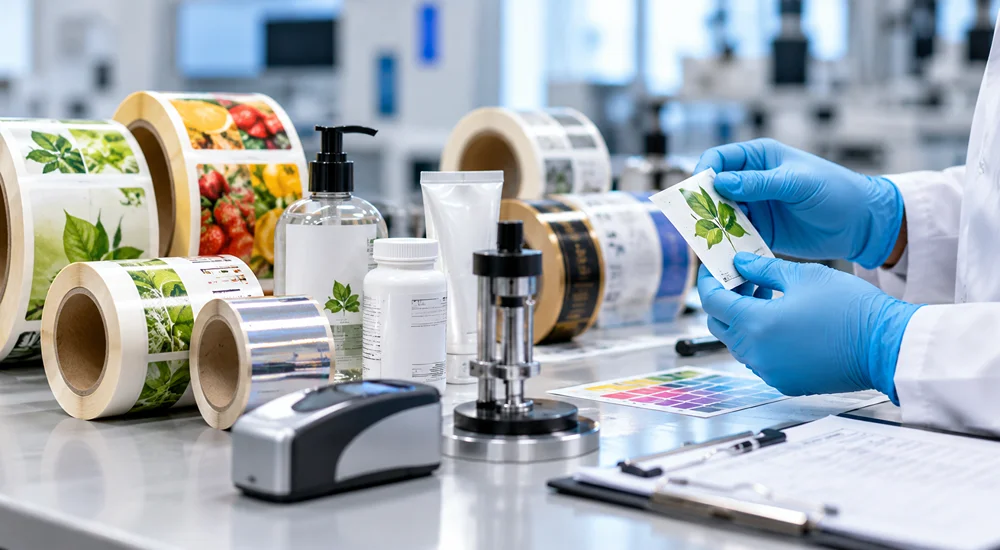
Receiving a large batch of printed labels is not the point at which quality should be taken for granted. Before accepting the shipment, buyers should verify whether the labels match the approved artwork, meet agreed specifications, scan correctly, and can withstand the conditions they will face during application, storage, transportation, and use.
Effective label quality testing helps identify issues before defective labels reach production or finished products reach customers. A proper label inspection should cover both visual quality and functional performance, including print accuracy, colour consistency, dimensions, barcode readability, surface defects, and application requirements. Modern inspection processes can also verify variable data, missing or duplicate codes, and barcode quality.
For packaging buyers, the goal is simple: confirm that the delivered batch matches the approved standard before it enters production.
What Should You Check Before Accepting a Label Batch?
A label batch should be evaluated against the approved artwork, specifications, reference sample, and agreed quality requirements. Visual inspection alone is not enough for labels containing barcodes, QR codes, batch information, or other variable data.
A practical incoming inspection should cover:
Artwork & content – Verify product name, logo, graphics, mandatory information, and artwork version.
Print quality – Check sharpness, clarity, registration, ink coverage, and consistency.
Colour accuracy – Compare colours with the approved reference or agreed colour standard.
Dimensions – Confirm label length, width, shape, and other agreed specifications.
Codes & variable data – Test barcodes and QR codes for readability and verify batch, lot, date, or serial information where applicable.
Physical condition – Look for wrinkles, scratches, tears, bubbles, contamination, missing print, and other defects.
Application performance – Confirm that the label material, adhesive or decoration is suitable for the intended container and application process.
7 Key Areas of Label Quality Testing
1. Print and Artwork Accuracy
Start by comparing the delivered labels with the approved artwork or master sample. Check the brand logo, product name, graphics, text, symbols, and other critical elements.
Look for common print defects such as smudging, missing print, distortion, misalignment, streaks, and incorrect artwork versions. Automated inspection systems can identify print defects and compare label content against expected data.
2. Colour Consistency
Colour plays an important role in brand recognition, particularly when the same packaging design is produced repeatedly.
Compare the batch against the approved colour reference and look for noticeable variation between labels or across the production run. For high-value brand colours, objective colour measurement can provide more reliable results than visual comparison alone. Professional print inspection systems can measure colour values and compare them with defined standards.
3. Label Dimensions and Registration
Incorrect dimensions can create problems during automatic or manual application. Check the label’s width, height, die-cut shape, spacing, and print-to-cut registration against the approved specification.
A label can have excellent printing quality but still fail operationally if its dimensions or positioning are outside the required tolerance.
4. Barcode and QR Code Readability
Never assume that a barcode is acceptable simply because it looks clear to the eye.
Use an appropriate scanner or verifier to confirm readability. GS1 India highlights factors such as barcode size, contrast, quiet zones, orientation, and placement as important considerations for reliable scanning.
For labels used in retail and supply-chain applications, barcode verification should be part of the label inspection process.
5. Surface and Physical Defects
Inspect samples for:
- Scratches
- Wrinkles
- Tears
- Bubbles
- Edge damage
- Smudges
- Missing print
- Contamination
- Uneven finishing
These defects can affect both appearance and application performance. A label may be technically printable but still unsuitable if physical defects affect its appearance or ability to run smoothly on the packaging line.
6. Adhesion and Application Performance
For adhesive labels, check whether the label bonds correctly to the intended container surface. Performance can vary depending on the substrate, surface condition, temperature, moisture, and application process.
For other technologies such as shrink sleeves or heat transfer labels, the relevant performance checks will be different. The test should therefore reflect the actual labeling technology and final packaging application.
7. Batch-to-Batch Consistency
A single good-looking sample does not necessarily represent the entire production batch.
Take samples from different points within the batch and compare:
Colour → Print → Dimensions → Codes → Surface → Application performance
This helps identify variation that may not be visible when checking only the first few labels.
Label Testing Should Match the Final Application
The correct quality checks depend on where and how the labels will be used.
A food label may require particular attention to readability, moisture exposure, and regulatory information. A lubricant or automotive label may need stronger resistance to oils, chemicals, abrasion, or handling. Cosmetic and personal care packaging may place greater emphasis on premium print quality as well as resistance to moisture and frequent handling.
This means there is no universal label testing checklist that applies identically to every product.
The most effective approach is to define acceptance criteria around:
- Label material
- Container surface
- Application method
- Product environment
- Storage conditions
- Transportation
- Required durability
- Printing specifications
- Barcode or QR requirements
What Makes a Label Batch Acceptable?
Before approving a batch, compare the delivered labels against the approved specification rather than personal preference.
A simple acceptance framework can include:
Quality Check | Acceptance Basis |
Artwork | Matches approved artwork |
Colour | Within agreed specification |
Sharp, complete and consistent | |
Dimensions | Within approved tolerance |
Barcode/QR | Readable and correctly encoded |
Physical condition | Free from unacceptable defects |
Material | Matches approved specification |
Application | Performs as required |
Batch consistency | Consistent across sampled rolls or packs |
For critical applications, acceptance criteria should be agreed between the buyer and label manufacturer before production begins. This reduces disagreements during incoming inspection.
Why Approved Samples Matter in Label Quality Inspection
An approved physical sample or controlled digital master gives both the buyer and manufacturer a common reference point.
Without an agreed standard, terms such as “slightly darker,” “minor scratch,” or “acceptable colour difference” can become subjective.
Before bulk production, establish:
Approved artwork + Material specification + Colour reference + Dimensional tolerance + Defect criteria + Application requirements
This creates a clearer quality benchmark for future batches and makes repeat production easier to control.
When Should a Label Batch Be Rejected?
A batch should be investigated or rejected when defects exceed the agreed acceptance criteria or when critical information is incorrect.
Examples include:
- Incorrect product artwork
- Wrong product or SKU information
- Unreadable barcode or QR code
- Missing mandatory information
- Significant colour deviation
- Incorrect dimensions
- Material mismatch
- Poor adhesion or application performance
- Excessive physical defects
- Significant variation between samples
Not every visual imperfection automatically means an entire batch should be rejected. The decision should be based on pre-agreed specifications, sampling plans, defect classification, and the intended application.
How Ideal Wrappers Approaches Label Quality
At Ideal Wrappers, quality is an important part of producing labels for different packaging applications. The appropriate inspection criteria depend on the labeling technology, material, product category, and final application.
Whether the requirement involves heat transfer labels, shrink sleeves, self-adhesive labels, or wrap-around labels, quality evaluation should go beyond appearance. Print accuracy, material suitability, dimensional consistency, application requirements, and end-use conditions all need to be considered.
For buyers, working with an experienced label manufacturer in India and establishing specifications before production can help create clearer expectations for every batch.
Label Quality Testing Checklist for Buyers
Before accepting a batch, use this quick checklist:
- Artwork: Does it match the approved version?
- Colour: Is it consistent with the approved reference?
- Print: Are text and graphics sharp and complete?
- Dimensions: Do measurements meet the agreed specification?
- Barcode/QR: Does it scan correctly?
- Material: Is the correct substrate or label construction supplied?
- Surface: Are there unacceptable scratches, wrinkles, bubbles, or tears?
- Application: Does the label perform correctly on the intended container?
- Consistency: Does quality remain uniform across the batch?
- Documentation: Are inspection results and deviations recorded?
Keeping inspection records is useful for resolving future quality questions and maintaining consistency between repeat orders.
Conclusion
Good label quality is not simply about whether a label looks attractive. It is about whether the entire batch meets the agreed requirements and performs correctly in its intended application.
At Ideal Wrappers, we understand that different industries and packaging formats require different quality considerations. From colour consistency and print clarity to material suitability and application performance, the right label inspection process helps manufacturers maintain reliable packaging quality from production through the supply chain.
With decades of experience in packaging and labeling, Ideal Wrappers works across heat transfer labels, shrink sleeves, self-adhesive labels, and other labeling solutions, helping manufacturers select solutions according to their product, container, and performance requirements.
For buyers, the best time to identify a label-quality problem is before the batch enters production, not after the finished products reach the market.
Frequently Asked Questions
What is label quality testing?
Label quality testing is the process of checking printed labels against approved specifications to verify print quality, colour, dimensions, codes, physical condition, and application performance before the batch is accepted.
What should I check when inspecting printed labels?
Check artwork accuracy, colour consistency, print sharpness, dimensions, barcode or QR readability, material, physical defects, and suitability for the intended application.
How do you test barcode quality on labels?
Use an appropriate barcode scanner or verifier to check whether the barcode can be reliably decoded. Factors such as size, contrast, quiet zones, orientation, and placement can affect scanning performance.
What are common defects found during label inspection?
Common defects include missing or blurred print, misalignment, colour variation, scratches, wrinkles, tears, bubbles, barcode problems, incorrect data, and material or application issues.
What should be agreed with a label manufacturer before production?
Buyers should agree on artwork, materials, dimensions, colour references, tolerances, barcode requirements, acceptable defect limits, application conditions, and other relevant quality specifications before bulk production begins.