
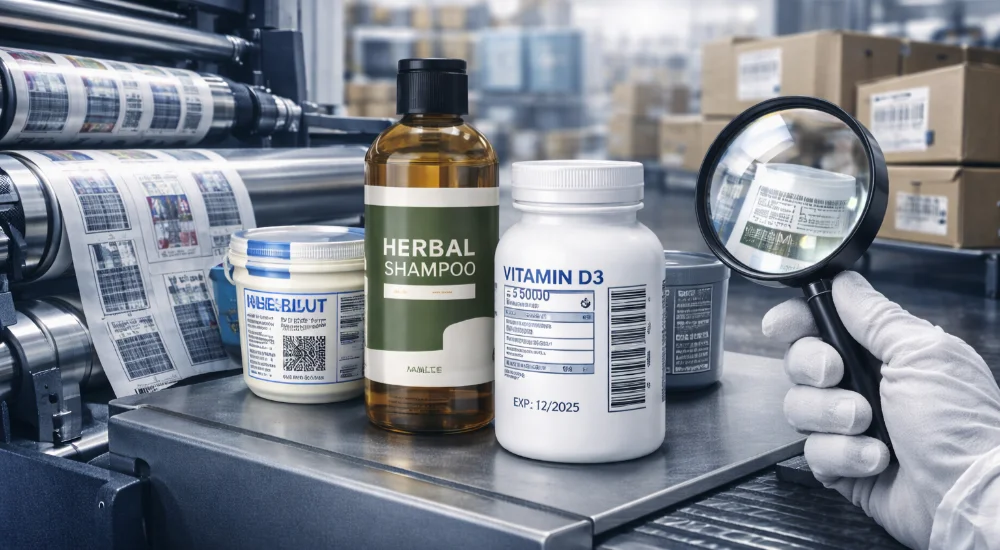
Product labels improve safety and traceability by communicating essential handling information and providing identifiers such as batch numbers, lot codes, barcodes, and QR codes. For manufacturers, durable and readable labels help ensure this information remains accessible throughout the supply chain, supporting product identification, compliance, and recall management.
For manufacturers across paints, lubricants, food, personal care, and agriculture sectors, product packaging and labeling is not just a marketing decision. It is a safety system. When it works well, it protects the buyer and the brand alike. When it fails, the consequences go far beyond the label itself.
What Is the Role of Product Labeling?
Product labeling helps manufacturers communicate safety information, meet applicable labeling requirements, and track products through the supply chain. Batch numbers, lot codes, barcodes, and QR codes provide product identifiers that can support inventory tracking, quality control, and targeted recalls.
What Product Labeling for Safety Actually Means?
Most people think of safety labeling as warnings printed in small text at the bottom of a container. In reality, it covers everything on the label that helps a buyer or a supply chain partner understand how to handle, store, use, and identify the product.
Mandatory Information That Must Appear on Every Label
In India, product packaging and labeling requirements are governed by several regulatory bodies depending on the product category. The Legal Metrology Packaged Commodities Rules 2024 require every pre-packaged product to carry the name and address of the manufacturer, net quantity, date of manufacture, and MRP. For food products, the FSSAI mandates batch identification numbers for traceability, date marking, and allergen declarations. The Plastic Waste Management Amendment Rules, effective from July 2025, further require barcode or QR code markings on plastic packaging for digital traceability.
These are not suggestions. Missing or inaccurate label information can result in fines, product recalls, and in serious cases, legal liability. For manufacturers whose products reach consumers at scale, every label printed is a compliance document as much as it is a branding surface.
Hazard Communication and Safe Handling
For products like lubricants, agricultural chemicals, and industrial paints, the label is the primary channel for communicating safe handling instructions. The Manufacture, Storage and Import of Hazardous Chemical Rules in India require that hazardous products carry proper safety classification and labeling. This means the label must do more than look good. It must clearly communicate storage conditions, usage instructions, and any warnings that protect the person handling the product.
A label that is hard to read, printed with poor contrast, or uses text that peels away or fades under handling conditions is not just a design problem. It is a safety failure.
How Product Labels Enable Supply Chain Traceability
Traceability is the ability to track a product from the point of manufacture through every stage of distribution to the end user. The label is the primary mechanism through which this tracking happens.
Batch Numbers and Lot Codes Are the Backbone of Traceability
Every product label that carries a batch number or lot code creates a traceable identity for that product. According to research published by SupplyChainBrain, when a product batch is affected by a quality issue, the assigned lot number allows manufacturers to immediately identify where the specific item is stored, isolate it, and pull it from the market. Without that number clearly printed on the label, there is no traceable record to act on.
This matters enormously in a recall situation. Research on product recall management shows that more than half of executives surveyed said it would take them longer than 48 hours to execute a recall. In many of those cases, the limiting factor is the inability to quickly identify and isolate the affected batch. A clear, durable label with a legible batch code is often the difference between a targeted, controlled recall and a full product line withdrawal.
Labels That Cannot Be Read Are Labels That Cannot Be Traced
Here is a point that does not get discussed enough in the context of product labeling for safety and traceability. A batch number printed in low resolution, on a material that does not adhere properly to the container, or with ink that degrades during transit, is effectively no batch number at all.
This is where the print quality of the label directly intersects with supply chain compliance. A heat transfer label bonded directly to a plastic pail, printed with sharp registration across 10 colours, holds its information through warehouse storage, transport, and retail handling in a way that a paper sticker applied over adhesive simply cannot guarantee. When traceability depends on a scannable barcode or a readable code, the durability and print quality of the label is a functional requirement, not an aesthetic preference.
Digital Traceability and What It Means for Labels Today
Traceability requirements are evolving rapidly. The Plastic Waste Management Amendment Rules 2025 in India now mandate QR codes on plastic packaging for digital tracking of products through the supply chain. Globally, the shift toward item-level traceability means that labels are increasingly expected to carry machine-readable identifiers alongside printed information.
For manufacturers currently using standard paper labels or low resolution print processes, this creates a compliance gap that will only widen as regulations tighten. Labels that are designed and printed to accommodate barcodes, QR codes, and batch information legibly and durably are becoming a baseline expectation, not a premium feature.
The Business Cost of Getting Labeling Wrong
The consequences of poor product labeling for safety and traceability are not abstract. They are measurable and they affect the bottom line directly.
Recalls Are Expensive and Brand Damaging
Research on product recall outcomes shows that 59% of consumers are reluctant to repurchase a product that has been recalled. A recall is not just a logistics problem. It is a trust problem. And when a recall happens because labeling was inadequate, the reputational damage is harder to recover from because the failure was preventable.
For manufacturers across food, personal care, agriculture, and consumer goods, investing in labels that clearly carry traceability information is not an additional cost. It is risk management.
Regulatory Non-Compliance Has a Growing Price
India’s regulatory environment around product packaging and labeling is becoming more demanding, not less. The Legal Metrology Rules 2024, FSSAI updates, BIS certification requirements, and the Plastic Waste Management Rules 2025 together represent a tightening framework that manufacturers cannot afford to treat casually. Labels that are inaccurate, incomplete, or printed on materials that degrade before the product reaches the consumer create compliance exposure that can result in fines, market withdrawals, and loss of certifications.
Why Label Quality Is Central to Safety and Traceability
It is not enough to have the right information. That information must remain readable and intact throughout the product’s journey from factory to end user.
Print Technology Determines Label Durability
Rotogravure printing, which uses a precision engraved cylinder to apply ink, produces labels with high colour consistency and excellent print sharpness across large volumes. This is significant for traceability because the fine detail required for barcodes, QR codes, and batch codes is rendered accurately and remains legible even on containers exposed to handling, moisture, and temperature variation during transit.
For manufacturers whose products sit in warehouses, travel across states, or are handled multiple times before reaching the buyer, the durability of the label print is directly linked to the reliability of their traceability system.
Label Type Must Match the Container and the Environment
A shrink sleeve on a beverage bottle, a heat transfer label on a paint pail, or a BOPP wrap-around label on an agricultural container each faces a different set of environmental conditions. The label must be chosen to survive those conditions while keeping its safety information readable. A label that wrinkles, peels, or fades before the product is sold is not just a branding problem. It removes the traceability information and the safety warnings that the buyer depends on.
Conclusion
For manufacturers in paints, lubricants, food and dairy, personal care, agriculture, and home care, the label on your product is doing more work than most people realise. It is communicating safety, enabling traceability, meeting regulatory requirements, and representing your brand to the buyer simultaneously.
At Ideal Wrappers, we manufacture labels that are built to perform all of these functions reliably. Our heat transfer labels bond directly to plastic containers, keeping batch codes and safety information intact through the supply chain. Our shrink sleeves provide full body coverage with the print quality required for barcodes and regulatory text. Our BOPP wrap-around labels and metallized heat transfer labels are designed for the specific demands of the industries we serve.
Frequently Asked Questions (FAQs)
Why is labeling important for product safety?
Labeling is important for product safety because it provides clear instructions on usage, storage, and handling. It also communicates warnings and hazard information, helping prevent misuse and ensuring consumer protection.
How do labels help in product traceability?
Labels enable product traceability by including batch numbers, lot codes, barcodes, or QR codes. These identifiers allow manufacturers to track products through the supply chain and quickly identify affected batches in case of quality issues or recalls.
What information should be included in safety labeling?
Safety labeling should include manufacturer details, product name, batch number, manufacturing and expiry dates, usage instructions, storage guidelines, and safety warnings. This information helps ensure compliance and safe product handling.
What happens if labeling is incorrect or missing?
Incorrect or missing labeling can lead to regulatory penalties, product recalls, and loss of consumer trust. It also makes traceability difficult, increasing risks during quality issues or safety incidents.
Which industries require strong labeling for traceability?
Industries such as paints, lubricants, food, personal care, agriculture, and chemicals require strong labeling systems to ensure product safety, regulatory compliance, and supply chain tracking.