
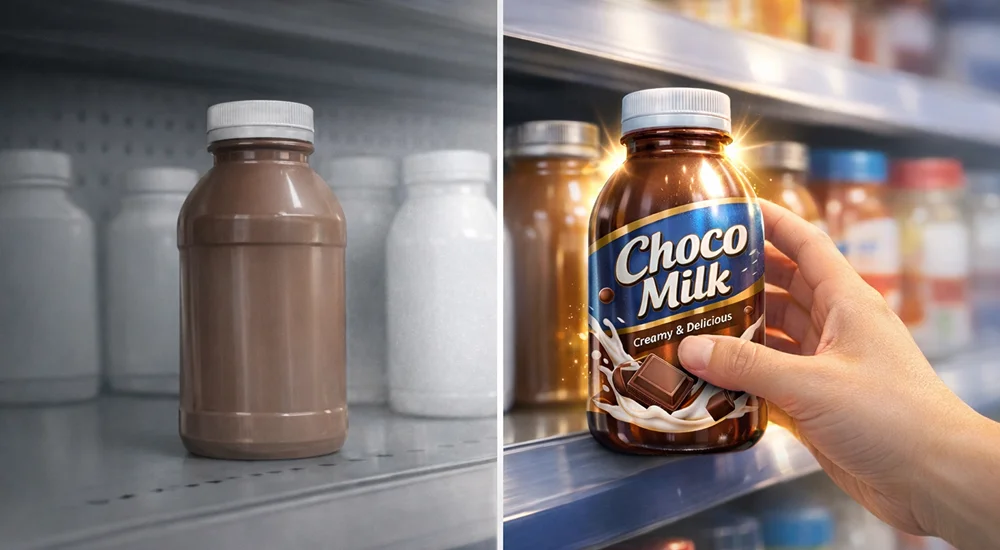
Packaging labels influence buying decisions by shaping first impressions, communicating product information, reinforcing brand identity, and helping products stand out at the point of purchase. Colour, typography, print quality, label finish, and information clarity can all affect how consumers perceive a product before they use it.
The label is the first thing a buyer sees. It creates an impression before anyone reads a single word. And research consistently shows that impression shapes whether a buyer picks up your product or reaches for the one next to it.
If you are a manufacturer using labels on your pails, bottles, containers, or consumer goods, understanding how packaging labels influence buying decisions is not just a branding conversation. It is a business conversation.
The Moment of Decision Happens Faster Than You Think
First Impressions Are Made in Seconds
According to a systematic review published in the International Journal of Food Science, consumers take an average of just 2.5 seconds to select a product from a shelf. In that window, there is no time to read specifications or compare ingredients. The eye makes the decision, and the brain follows.
This is the environment your label has to perform in. A well executed label does not just look good. It communicates the right message at the right moment, giving the buyer a reason to stop.
A Bad Label Actively Costs You Sales
A 2017 survey of 400 shoppers by Premium Label and Packaging Solutions found that 32% of consumers have disliked a label so much that they decided not to buy the product. And 60% said they are unlikely to purchase a product when the label does not provide enough information.
Your label is not a neutral element. It is either working for you or working against you.
How Visual Design on a Label Drives Purchase Behaviour
Colour Is the First Language Your Label Speaks
Before a buyer reads your product name, colour has already communicated something to their brain. Research consistently shows that approximately 75% of snap judgements about products are based on colour alone. In some studies, the figure reaches as high as 90%.
Colour is not decoration. It is communication. A bold, vibrant colour on a paint pail signals confidence and coverage. A deep, metallic tone on a lubricant container suggests durability and performance. A clean, bright palette on a food or dairy product signals freshness and safety. Every category has a colour language, and your packaging labels either speak it or they do not.
Print Quality Tells the Buyer How Much You Value Your Own Product
A buyer does not consciously think, “this label is printed with 10 colour rotogravure technology.” But they register the sharpness of the graphics, the consistency of the colour, the crispness of the text. High print quality signals that the manufacturer cares about the product inside.
This is one of the reasons brands choose heat transfer labels over basic paper stickers. The finish is seamless, the colour reproduction is rich, and the label wraps the container in a way that feels premium rather than stuck on. The buyer perceives that quality without being told about it.
Label Finish Creates a Feeling That Influences Trust
Beyond colour and print quality, the physical finish of a label creates a tactile and visual impression that affects how buyers perceive value. A standard matte label and a metallized heat transfer label can carry the exact same product information, but they will be perceived very differently.
The 2018 Ipsos survey conducted on behalf of the Paper and Packaging Board found that 67% of consumers say packaging materials influence their purchase decisions. This holds true across categories, from consumer goods and personal care to industrial products like paints and lubricants.
What Information on a Label Builds Buyer Confidence
Consumers Read Labels More Than Most Manufacturers Realise
A study by Acosta Group found that 58% of all shoppers read labels all or most of the time before purchasing a new item. For health-focused shoppers, that number jumps to 87%. And label reading is increasing, with 40% of health-focused shoppers and 39% of Gen Z consumers saying they read labels more often than they did six months before the study.
This means your label is not just competing visually. The information it presents is being evaluated. Buyers are checking for clarity, completeness, and honesty.
Clarity and Completeness Drive Purchase Confidence
Research published on PMC (National Center for Biotechnology Information) found that easy to read labels are highly effective and that clear label information is pivotal for shaping consumer attitudes, even toward unfamiliar products being purchased for the first time.
When a buyer encounters your product for the first time and the label clearly tells them what it is, what it contains, and why it is the right choice, the decision becomes easy. When the label is cluttered, vague, or hard to parse, the buyer moves on to something that does not require effort.
Transparency Builds Loyalty That Goes Beyond the First Purchase
Label Insight’s Transparency ROI Study, which surveyed more than 2,000 consumers, found that 73% of respondents would be willing to pay more for a product that offers complete transparency. More significantly, 94% said they were likely to be loyal to a brand that offers complete transparency.
Loyalty built through clear labelling means repeat purchases, brand advocacy, and a consumer base that is harder for competitors to pull away.
How Different Label Types Serve Different Buyer Expectations
Heat Transfer Labels for Pails and Industrial Containers
If your product goes into plastic pails, the label technology you choose has a direct impact on how your product is perceived at the point of purchase. Heat transfer labels bond directly to the container surface, creating a seamless, wrap-around print with no edges to peel and no paper backing to distort. The result is a container that looks finished and professional rather than labelled and shipped.
For paint pails, lubricant containers, and agriculture products, this level of presentation matters to buyers who associate packaging quality with product quality. A label that looks precise communicates that the product inside was made with the same precision.
Metallized Heat Transfer Labels for Premium Shelf Impact
When a product needs to stand out in a competitive retail environment, a standard label often is not enough. Metallized heat transfer labels add a premium metallic finish to the container surface, creating a visual impact that catches the eye at a distance and communicates quality up close.
This is particularly relevant for products where perceived value influences the purchase decision. In personal care, cosmetics, and premium consumer goods, the metallic finish signals quality in a way that a flat printed label simply cannot.
Shrink Sleeves for Full Body Coverage and Tamper Evidence
Shrink sleeves, available in both PVC and PETG, offer label coverage that wraps the entire container, including curved, tapered, and irregular surfaces. This gives the manufacturer 360 degrees of usable print area, which means more space for branding, product information, regulatory requirements, and visuals.
For beverages, food and dairy, home care, and beauty products, shrink sleeves also provide tamper evidence, which is an increasingly important trust signal for buyers. Seeing a sealed, intact sleeve tells the consumer the product has not been opened or interfered with. That reassurance supports the buying decision before a single word on the label is read.
Wrap Around Labels for Clean, Consistent Branding
BOPP wrap-around labels, available in transparent, pearlized, laminated, and holographic substrates, offer versatile labelling for a wide range of container shapes and product categories. They apply efficiently on automated high-speed production lines and deliver consistent print quality across large production volumes.
For manufacturers producing at scale across multiple SKUs, consistency in label quality across every container in every batch is itself a form of brand communication. A consumer who buys your product six months apart should receive the same visual experience both times.
7 Label Factors That Can Influence Product Perception
A label can significantly affect how consumers perceive a product. Key factors include:
- Colour Accuracy – Consistent colours strengthen brand recognition and create a professional appearance.
- Print Quality – Sharp graphics and clear text improve perceived product quality.
- Information Clarity – Easy-to-read product details help consumers make confident decisions.
- Label Finish – Matte, gloss, or metallic finishes can support different brand positioning.
- Durability – Labels should remain intact and readable despite handling, moisture, and transportation.
- Brand Consistency – Consistent design across SKUs builds familiarity and trust.
- Label Technology – Choosing the right solution, such as heat transfer, shrink sleeves, or self-adhesive labels, ensures the packaging performs as intended.
What 35 Years of Label Manufacturing Has Taught Us About Buyer Perception
After 35 years in the labeling and packaging industry, one thing has remained consistent: buyers often judge a product by its packaging before they experience the product itself. A label is not simply a space for a logo or product information, it contributes to how consumers perceive quality, reliability, and brand value.
From our experience at Ideal Wrappers, several factors consistently influence how a product is perceived on the shelf. Colour accuracy and print quality help maintain a professional brand image, while clear typography and well-organized information make products easier to understand. Similarly, a label that remains intact, vibrant, and readable during transportation, storage, and handling can reinforce the perception of product quality.
What We Have Learned Over the Years
Consistency builds recognition: When colours, logos, typography, and design elements remain consistent across batches and product variants, consumers can recognize the brand more easily.
Print quality affects perceived value: Sharp graphics, accurate colours, and well-executed finishes can make packaging appear more premium and professionally manufactured.
Durability protects brand perception: Peeling, fading, scratching, or damaged labels can make even a quality product appear less reliable. The right labeling solution should suit the container, product, and handling environment.
The right label technology matters: Heat transfer labels, shrink sleeves, self-adhesive labels, and other solutions each have different strengths. Selecting the appropriate technology helps ensure that the packaging delivers both visual impact and functional performance.
Ultimately, effective labeling is about finding the right balance between design, durability, readability, and brand consistency. These practical considerations are what help transform packaging from simple product identification into a stronger brand communication tool.
The Buying Decision Is Cumulative, Not Instant
Every Label Element Adds Up to a Perception
The buying decision a consumer makes in 2.5 seconds is actually the sum of many small signals processed at once. Colour, print quality, finish, information clarity, and visual structure all contribute to a single overall impression. That impression either matches what the buyer expects from a quality product in your category, or it does not.
This is why label design cannot be approached as a single isolated decision. The label type, the print technology, the colour strategy, the information hierarchy, and the material finish all need to work together. When they do, the result is a label that does not just inform the buyer but convinces them.
Research Confirms That Label Quality Influences Quantity Purchased
A regression analysis published in ResearchGate on the positive role of packaging in consumer behaviour found that consumers purchase more of a product after encountering a well labelled version. Better labels do not just convert the first purchase. They affect how much a buyer takes.
For manufacturers, this means that investment in label quality is not a cost that sits outside the commercial equation. It is a variable that directly affects revenue per customer interaction.
Conclusion
You are already making decisions about label quality every time you choose a label supplier and a label type. The question is whether those decisions are being made with a clear understanding of what is at stake at the point of sale.
Your buyer is forming an opinion about your product before they open it. They are doing it in seconds, based on what they see and feel. A label that looks cheap makes your product look cheap, regardless of what is inside. A label that looks premium, wraps cleanly, prints crisply, and communicates clearly makes your product look like the obvious choice.
At Ideal Wrappers, we have spent close to 35 years manufacturing packaging labels for some of India’s most recognised brands across paints, lubricants, food and dairy, personal care, agriculture, and home care. Our labels are designed to perform at the shelf, on automated application lines, and through every stage of the supply chain.
Frequently Asked Questions
How do packaging labels influence buying decisions?
Packaging labels influence buying decisions through visual cues like colour, print quality, and finish that create an immediate impression of product quality. Research shows consumers take just 2.5 seconds to select a product on a shelf, meaning the label has to communicate trust and value before a single word is consciously read.
What type of label is best for plastic pails and industrial containers?
Heat transfer labels are the most effective option for plastic pails. They bond directly to the container surface, creating a seamless wrap-around print with no edges, no peeling, and a finished look that communicates quality at the point of sale.
Do shrink sleeves help with consumer trust at the point of purchase?
Yes. Shrink sleeves provide tamper evidence, which is a direct trust signal for buyers. A sealed, intact sleeve tells the consumer the product has not been opened or interfered with, which supports the buying decision before the label content is even read.
Why do some brands choose metallized heat transfer labels over standard labels?
Metallized heat transfer labels add a premium metallic finish to the container that creates a stronger shelf impact and signals higher product value. For categories like personal care, cosmetics, and premium consumer goods, the finish influences perceived quality in a way a flat printed label cannot match.
How does print quality on a label affect consumer perception?
High print quality signals that the manufacturer cares about the product inside. Sharp graphics, consistent colour, and crisp text create a subconscious impression of precision and reliability, even when the buyer does not consciously analyse the label.